
Powder organic fertilizer plant
A powder plant is the shortest route from feedstock to a saleable product: crush, screen, blend, bag. No dryer, no granulator, no thermal load — and t

Weighing, tipping and removal of plastic, stone and metal. Contamination that reaches the turner or the granulator costs far more to remove later than at the reception bay.
Manure is blended with carbon-rich amendments to reach 50–60% moisture and a C/N of 25–30 : 1. This step decides the fermentation performance more than any machine downstream.
Thermophilic composting in windrow, bay, aerated pile or vessel, holding 55–65 °C for the sanitation period with recorded turning or aeration.
Two to six weeks at lower temperature: maturity, moisture equilibration, and the end of reheating risk in the bag.
Cured material reduced to below 3–5 mm. Moisture above about 20% blinds screens, so moisture control precedes fineness.
Classification of the ground material; oversize returns to grinding or to the fermentation bays as a bulking agent.
Formulation blending with minerals or bio-inoculants where the product requires it, then bagging. No thermal process is needed.
Disc, drum or extrusion granulation to 2–4 mm with a binder; the moisture added here decides the dryer load.
Moisture reduced to 12–14% and the product cooled to near ambient before screening, so that granules do not deform or cake.
Size classification to the saleable fraction, recirculation of fines, and coating for anti-caking or controlled release.
Weighing, sealing, check-weighing, palletising where required, and dry covered storage.
| Step | Target moisture | Consequence if not held |
|---|---|---|
| Fermentation feed | 50–60% | Below 40%: process stalls. Above 65%: anaerobic, odour, slow degradation |
| Cured material | 25–35% | Too dry: dust and poor granule formation. Too wet: screening blinds and dryer overload |
| Granulation feed | 25–30% | Outside the range, granules are weak or the disc/drum balls up |
| After drying | 12–14% | Above this, product cakes in store and weakens in the bag |
| Bagged product | ≤ 14% | Moisture regain in an open store undoes the drying work |
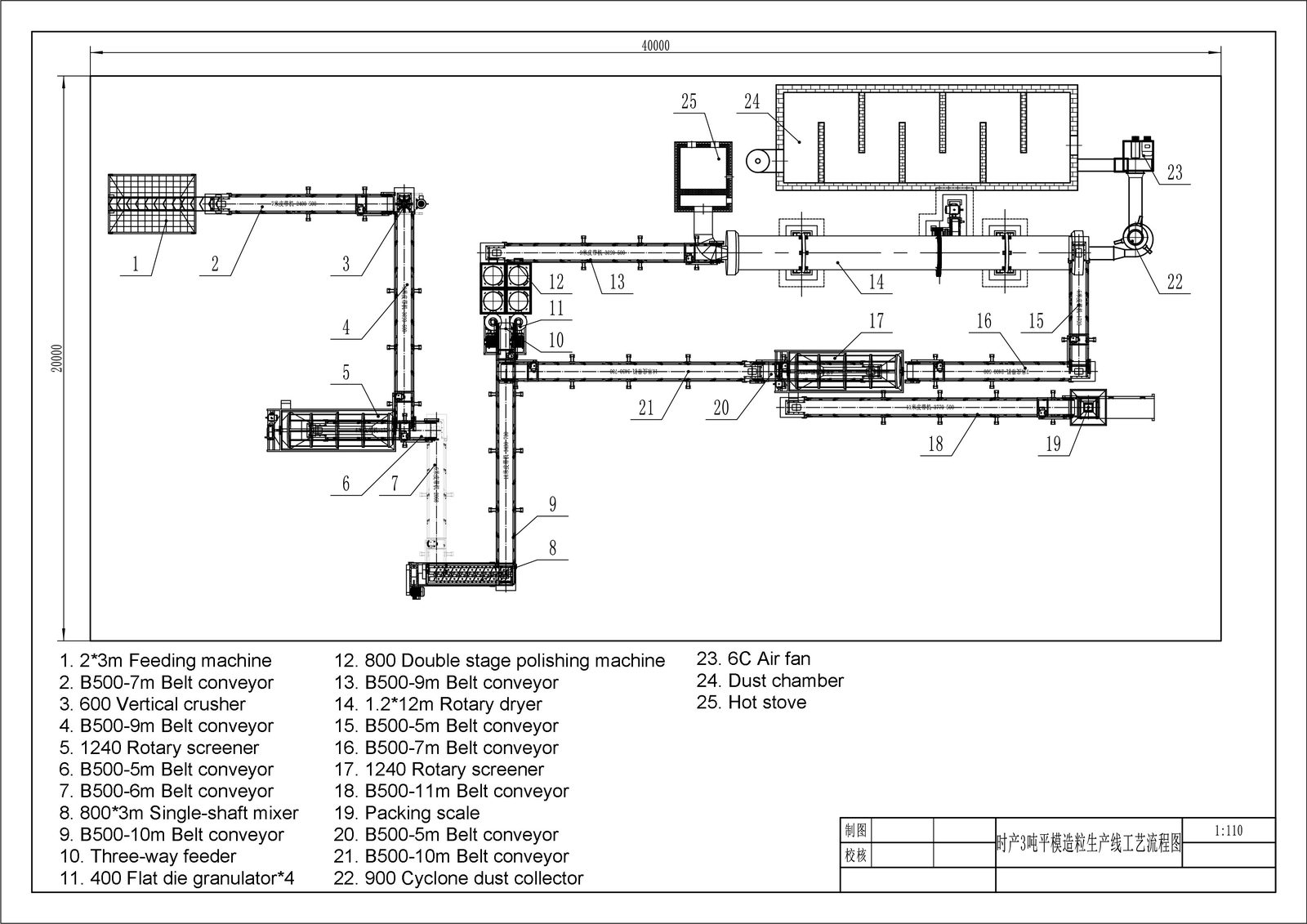
The notes below come from our own plant records and describe the powdery and granular production routes in the detail of a working plant.
Different with chemical fertilizer, organic fertilizer derived from organic waste. On the contrary, chemical fertilizer is always made from artificial nutrient elements. Because the long application of chemical fertilizer will cause adverse effect on plants and soil, organic fertilizer become more and more popular. Organic fertilizer is not only beneficial for soil and plants, but also realize the recycle of organic waste. In terms of final products, organic fertilizer production process includes powder production and granules production. On the other hand, organic fertilizer production process includes two phases, composting and deep processing. The detailed information will be introduced below.
How to manufacture organic fertilizer? As mentioned above, organic fertilizer production process consists of composting organic waste and deep processing of fermented organic waste. Because the direct use of organic waste will do harm to soil and roots of plants and crops. On the other hand, composting can convert organic material to humus by microorganism activity. In addition, organic waste includes manure from livestock and poultry, agricultural waste, oil cake, and so on.
Composting organic waste Composting period is also a fermentation process. Firstly, you should pile organic waste together, in a groove or on the ground. Secondly, you should regularly turn the compost pile to accelerate composting period and prevent anaerobic fermentation. Finally, when the organic waste becomes black and loose, temperature maintains steady, and the odor disappears, fermentation process finishes. In the process, microorganisms will decompose organic materials and convert them into humus. At the same time, microorganism activity will produce amounts of heat and consume oxygen. For one thing, higher temperature will kill harmful bacteria, eggs and grass seed. For the other thing, too high temperature and less oxygen content will inhibit the microorganism activity, and then influence composting result. Therefore, you should pay more attention to the following aspects.
Important factors need your attention The water content of organic waste for composting: the water content for composting usually keep in 50% to 60%. For materials with high water content, you can adopt solid-liquid separator machine to adjust water content. On the other hand, you can add some saw dust, straw and rice straw to adjust water content and improve the C/N ratio. Regularly turn the compost pile: After making a compost pile, the temperature will gradually increase. When the temperature achieve 60℃ or 70 ℃, you can turn the compost pile. On the other hand, turning organic waste can adjust temperature, oxygen content and water content. On the other hand, blending the compost pile can make the fermentation more thorough and evenly. In this process, you can adopt compost turner for quick composting.
Deep processing of organic fertilizer The deep processing includes powdery organic fertilizer production line and granular organic fertilizer production line. On the one hand, the production of powdery fertilizer is simpler than that of granular fertilizer. That is to say, powdery organic fertilizer production needs less equipment. On the other hand, granular organic fertilizer is more convenient for transport, storage and application. You can choose suitable production line according to your actual requirements.
Powdery organic fertilizer production
After composting, organic waste has become organic fertilizer. In this process, you need the following steps and organic fertilizer production plant. Crushing: In order to produce homogeneous powdery organic fertilizer, you can adopt New type vertical crusher to deal with potential caking. Screening: In order to guarantee the purity and high quality of organic fertilizer, you need select other materials in the organic fertilizer. In this step, you can use Rotary screen machine. It is featured with high screening efficiency, low noise, small amount of dust, long service life and less maintenance. Packaging: After screening, organic fertilizer will enter next step, packaging. There are single and double bucket automatic packing scale for you to choose. If you want higher packing efficiency, you can adopt double bucket automatic packing machine, which can produce two different qualities at the same time.
Granular organic fertilizer production Granular organic fertilizer production process is more complex. Because the granulating process, you may need more machines. And the detailed steps and equipment are as follows.
Crushing and mixing: Because granule making has higher standard on organic fertilizer powder, you should guarantee homogeneous powder. Meanwhile, you can add other functional bacterial or nutrient elements in this step, so as to produce organic fertilizer with specific fertilizer effect. Therefore, we recommend semi-water material crusher and disc mixer to you. And the disc mixer is used for blending the organic fertilizer evenly.
Granulating: In this step, powdery organic fertilizer will be granulated into pellets. There are three types organic fertilizer granulation machines, including Pan Granulator, New type organic fertilizer granulator and Rotary Drum Churning Granulator. All of them adopts wet granulation. They are different in structure, but all of them has high granulating rate of 93%. Drying and cooling: This step is mainly for decreasing the water content of organic fertilizer pellets, so as to make the pellets more compact and improve storage time. Screening: The screening machine here can separate unqualified organic fertilizer pellets from qualified pellets. And then belt conveyor will send unqualified pellets to crushing machine for secondary granulating, and qualified pellets to packaging machine. Packaging: In order to meet customers requirement, you need to package these pellets. Besides automatic packaging machines, there are many auxiliary machines. And they include sewing machine, automatic counting, infrared trimming and folding machine, which will improve working efficiency.
What is organic fertilizer used for? Organic fertilizer is rich in nutrient elements, organic acid and humus. In addition, the long-term application of it will fertile the soil and eliminate the adverse effect caused by chemical fertilizer. On the other hand, organic fertilizer can increase microbial content in the soil and improve the quality of crops. Therefore, you can use it in gardens, vegetable farm and so on. Moreover, you need choose different organic fertilizer according to applicable objects. 2 Ton Per Hour Cow Dung Organic Fertilizer Production Being Installed in Uzbekistan
How to make a reasonable plan for organic fertilizer production process? In order to bring you considerable income or take full advantage of organic waste, you should make a perfect production plan. According to our experience, you can take the following aspect into account. Budget: The budget includes two aspects, raw material adopted and budget on equipment purchasing. On the one hand, you can choose organic waste according to that you have or near you, so as to lower cost. On the other hand, you can choose equipment according to your requirements on production capacity and site you have. If you still have no clear idea on production capacity, you can send your requirements to us. We have professional engineer, who can provide you different sample business plans for organic fertilizer.
Typically 8–14 weeks: 2–5 weeks fermentation depending on the system, 2–6 weeks curing, and a few hours on the processing line. Fermentation and curing dominate; the processing line itself runs in minutes.
You can, but the product will usually keep heating and releasing moisture in the bag, and the granulator will receive material of inconsistent moisture. Curing is the cheapest quality control step in the plant.
In granular plants, the dryer. In powder plants, the screener when material is wet. Both are consequences of the moisture balance upstream rather than of the machine itself.
Yes for some feedstocks and binders — extrusion granulation can produce saleable granules at lower added moisture. The trade-off is granule shape and strength, and the decision belongs in the design basis.
Tell us the feedstock, the daily tonnage and the product you want to sell. The engineering team replies with the plant configuration, the equipment scope and the information we still need before layout drawings start.
Prefer to talk first? WhatsApp +86 182 0399 3035 or email [email protected].
Two or three details are enough to start — the engineering team will come back with the configuration and the missing design basis.